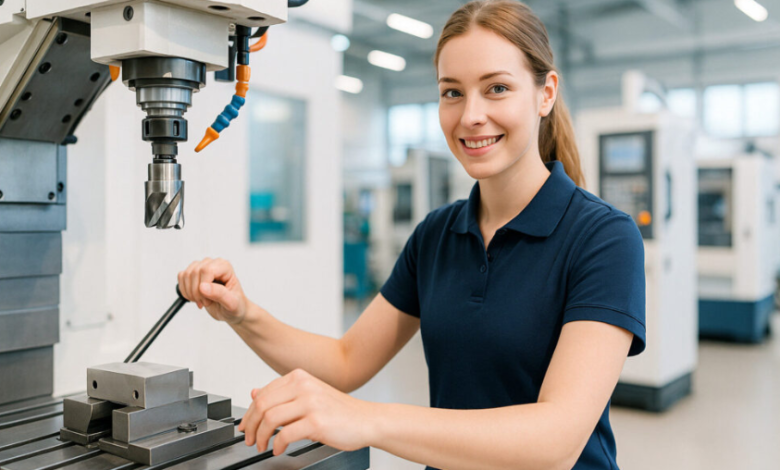
Introduction to Advanced Bending Technology
In today’s manufacturing world, accuracy and efficiency are paramount, especially in metal fabrication. Components must be bent with precision to meet industry standards, minimize waste, and ensure structural integrity. One key technology that has transformed this process is the back gauge for press brake, which plays a critical role in positioning materials for accurate bending. Its integration into modern press brakes has allowed manufacturers to achieve higher productivity and consistent results.
Understanding the functionality, advantages, and applications of back gauges for press brakes can help industries optimize production and maintain stringent quality standards.
What is a Back Gauge for Press Brake?
A back gauge for press brake is a mechanical or automated device that accurately positions a metal sheet before bending. It acts as a stop point, ensuring the material is correctly aligned relative to the press brake punch and die. By providing back gauge for press brake repeatable positioning, the back gauge helps maintain precise bend angles and locations, reducing errors caused by manual measurement.
Modern systems often integrate with CNC controls, allowing programmable positions and automated sequences. This ensures consistent performance, even when handling complex or custom parts.
Components of a Press Brake Back Gauge
A back gauge for press brake typically consists of several key components:
- Gauge Fingers: These adjustable stops make contact with the sheet to define the bending point.
- Linear Rails and Actuators: These mechanisms move the gauge accurately along horizontal and vertical axes.
- CNC Control Systems: Programmable interfaces allow precise positioning and repeatable sequences.
- Sensors and Feedback Devices: These components ensure the gauge is correctly aligned and detect obstructions to prevent damage.
Advanced back gauges may feature multiple axes of movement, enabling operators to manage asymmetrical parts, varying sheet lengths, and angled bends without manual repositioning.
Advantages of Using a Back Gauge for Press Brake
Improved Accuracy and Consistency
The primary advantage of using a back gauge for press brake is precision. By automating positioning, manufacturers can eliminate errors from manual alignment, ensuring that every bend meets specifications. This consistency is essential for industries requiring high tolerance, such as aerospace, automotive, and electronics.
Enhanced Production Efficiency
Manual repositioning of metal sheets can slow down production. Back gauges streamline this process by automatically positioning the workpiece, significantly reducing cycle time. CNC-controlled systems further enhance efficiency by executing multiple bend sequences without operator intervention.
Flexibility in Part Design
Modern back gauges allow manufacturers to handle a wide variety of part sizes and designs. Programs can be stored for specific operations, enabling quick changeovers between different parts and reducing downtime. This flexibility is invaluable for businesses producing both high-volume standard components and custom, low-volume parts.
Increased Safety
Handling heavy metal sheets manually can be dangerous. Back gauges reduce direct contact between operators and moving parts, minimizing the risk of injury. Additionally, integrated sensors and emergency stop features provide extra safety during automated operations.
Applications Across Industries
Back gauges for press brakes are widely used in industries that require precise bending:
- Automotive: Ensuring structural components, brackets, and panels are accurately bent for assembly.
- Aerospace: Producing high-precision, lightweight parts where tight tolerances are critical.
- Electronics: Fabricating enclosures and panels with exact dimensions for assembly and heat management.
- Construction: Producing metal frameworks and architectural panels that require consistent bends for safety and aesthetics.
In each of these applications, the back gauge ensures parts are positioned correctly, reducing errors and improving overall quality.
See also: Integrating AI and Telegram: How Blum’s Technological Innovations Affect Blum Price
CNC Integration and Automation
CNC integration has revolutionized back gauge operations. With CNC controls, manufacturers can program multiple bend sequences, compensate for material springback, and automate positioning. This technology reduces the need for manual intervention and increases throughput.
Advanced CNC systems also allow for simulation of bending sequences before production. This ensures that any potential collisions are avoided, gauge positions are optimized, and setup time is minimized, all without wasting material.
Maintenance and Calibration
To maintain accuracy and performance, regular maintenance and calibration of back gauges are essential. Lubricating moving parts, checking alignment, and verifying positions with measuring tools are standard practices. Proper calibration ensures high-volume production maintains consistent quality and reduces the risk of scrap material.
Emerging Trends in Back Gauge Technology
The back gauge industry continues to evolve with technological advancements. Smart systems now offer adaptive positioning, predictive maintenance, and real-time monitoring. IoT-enabled devices track usage patterns, detect wear, and suggest maintenance before failure occurs, reducing downtime and operational costs.
Digital twin technology and simulation software are also being integrated into back gauge systems. Manufacturers can virtually model entire bending processes, reducing the need for physical prototypes, optimizing production sequences, and minimizing errors during actual fabrication.
Conclusion
A back gauge for press brake is an essential tool for modern metal fabrication, ensuring precise, repeatable positioning and high-quality bends. Its integration with CNC systems enhances efficiency, flexibility, and safety, making it indispensable in industries ranging from automotive to aerospace.
Investing in advanced back gauge technology allows manufacturers to reduce waste, maintain tight tolerances, and improve overall productivity. As technology continues to advance, the capabilities of back gauges will expand, further solidifying their role in achieving precision and efficiency in metalworking operations.
By leveraging the full potential of back gauges for press brakes, manufacturers can stay competitive, deliver higher-quality products, and streamline production processes in a rapidly evolving industrial landscape.