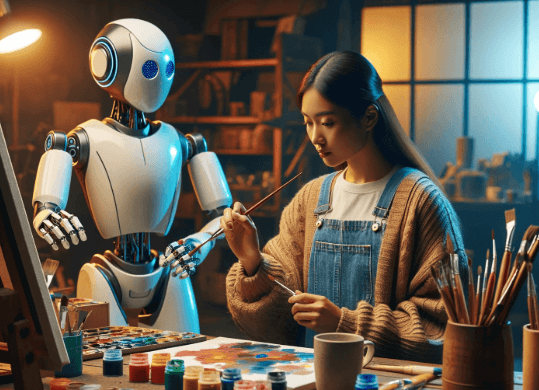
The emergence of AI in digital art challenges traditional notions of creativity. AI generates complex patterns and designs with remarkable efficiency. However, it often lacks the emotional depth that characterizes human artistry. This raises questions about the essence of art itself. Is it defined by technical prowess or by the human experience? As this discourse unfolds, the potential for a new paradigm in artistic creation looms on the horizon. What might this mean for the future of expression?
The Rise of AI in Digital Art
As technology continues to evolve, the integration of artificial intelligence into digital art has sparked a significant transformation in the creative landscape.
AI algorithms push the limits of artistic expression, enabling unprecedented technology advancements that challenge traditional creative boundaries.
This fusion of human inspiration and computational power fosters a new paradigm, inviting artists to explore innovative techniques while questioning the essence of creativity itself.
The Unique Touch of Human Creativity
While AI’s impact on digital art has opened new avenues for creativity, the unique touch of human artists remains irreplaceable.
Human creators infuse their work with artistic intuition, drawing from personal experiences and emotions. This emotional depth fosters connections that resonate with audiences, offering a richness often absent in algorithm-generated art.
Ultimately, it is this profound humanity that distinguishes their creations.
See also: How AI Is Enhancing the Quality of Vintage and Historical Footage
Comparing Techniques: AI vs. Human Artists
Although both AI and human artists employ distinct techniques to create visual art, their approaches highlight fundamental differences in process and intent.
Human artists often infuse their work with emotional depth, drawing from personal experiences, while AI leverages algorithmic creativity, generating patterns based on data.
This divergence underscores not only varying methodologies but also the contrasting motivations behind artistic expression in the digital age.
The Future of Digital Art: Collaboration or Competition?
The evolving landscape of digital art raises important questions about the relationship between AI and human artists, particularly regarding their potential for collaboration or competition.
As artists explore collaborative projects, they can blend AI’s computational power with their unique artistic vision, fostering innovation.
This partnership may redefine creativity, allowing both entities to thrive, rather than creating an adversarial dynamic that stifles artistic expression.
Conclusion
In conclusion, while some may argue that AI-generated art lacks the emotional depth characteristic of human creativity, this perspective overlooks the potential for a complementary relationship between the two. AI can enhance human artistry by providing novel ideas and techniques, while human artists can infuse their work with the personal experiences that resonate on an emotional level. Together, they can push the boundaries of digital art, creating a rich tapestry that transcends the limitations of either approach alone.